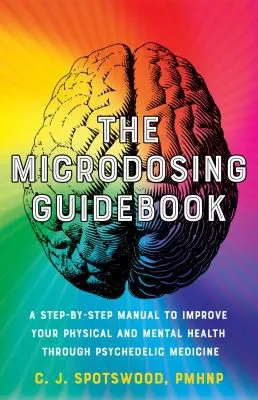
The Microdosing Guidebook
A Step-by-Step Manual to Improve Your Physical and Mental Health through Psychedelic Medicine
Our Review
C. J. Spotswood is a psychiatric-mental health nurse practitioner, and The Microdosing Guidebook reads like the handout a thoughtful clinician would give a patient who has already decided to try microdosing and wants to do it responsibly. The first third covers the essentials — what microdosing is and is not, the history from Hofmann and Fadiman to the present, and an honest survey of the research on psilocybin, LSD, MDMA and ketamine that separates what has been shown in trials from what is still anecdote. The tone is careful and clinical without being cold.
The remainder of the book is where it earns its title. Spotswood walks the reader step by step through preparation: screening for contraindications and medication interactions, choosing a protocol, setting a baseline, defining an intention, and deciding what to measure. Then come the worksheets — daily and weekly journal pages, mood and sleep trackers, prompts for reflecting on off-days — designed to be filled in over a full cycle. A chapter on integration explains how to review those notes at the end and decide whether to continue, adjust or stop. The limitation is that the workbook format assumes a printed copy; the research summaries are also brief compared with Fadiman or Nutt, and the book was written before the most recent placebo-controlled microdosing studies.
For MicrodosingDiary users this is almost a paper twin of the app. The daily prompts Spotswood suggests — dose, time, mood, sleep, energy, notable events — map directly onto the fields in a diary entry, and his insistence on establishing a baseline before the first dose is advice we repeat constantly. Readers who prefer a structured, checklist-driven approach and want a clinician's framing of safety will find it more useful than any memoir.
Key Takeaways
- ✓ Record a baseline of mood, sleep and energy for at least a week before the first dose, or you will have nothing to compare against
- ✓ Screen for medication interactions and personal or family history of psychosis before starting — a nurse practitioner treats this as non-negotiable
- ✓ A written intention turns a vague experiment into a testable question and gives your journal entries a focus
- ✓ Off-days are part of the protocol, not a break from it, and deserve the same journaling attention as dose days
- ✓ Reviewing a whole cycle of notes at the end is how you decide whether to continue, adjust or stop — single-day impressions are unreliable
Who Should Read This
People who have decided to try microdosing and want a structured, clinician-designed workbook to guide their first cycles. Best suited to readers who like checklists and worksheets, who are managing medication or a mental health history and want a safety-first framing, and who plan to track their experience systematically.
Available Editions
Related Content
Related Protocols
Related Substances
Related Terms
Important Legal Notice
⚠️ Personal Responsibility
You use this application entirely at your own risk and responsibility. MicrodosingDiary is only a tool for recording personal experiences.
🚫 Not a Medical Service
This application IS NOT a medical tool, does not provide medical advice, does not diagnose or treat any conditions. Always consult a qualified physician.
⚖️ Legislation and Laws
Many substances used for microdosing are illegal in many countries. Users are fully responsible for complying with local laws. The application does not support or promote illegal activity.
❌ No Guarantees
We provide no guarantees regarding results, safety or efficacy of microdosing. All information is for informational purposes only.
🔞 Age Restriction
Application is intended only for persons over 18 years of age. By using the application you confirm that you are an adult.
🔒 Data Privacy
Your diary entries are private and encrypted. The application is for personal use. Public-page analytics is described in Privacy and Terms.
By using this application you accept all the above risks and waive any claims against the application operator.