Plants of the Gods
Their Sacred, Healing, and Hallucinogenic Powers
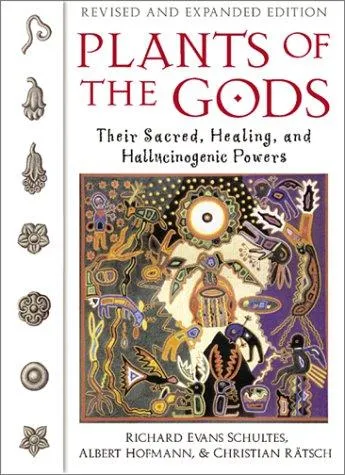
Our Review
Few books in this field carry the authority of Plants of the Gods. Richard Evans Schultes spent decades in the Amazon and effectively founded the discipline of ethnobotany; Albert Hofmann synthesised LSD and isolated psilocybin; Christian Rätsch, who revised and expanded the book for its 2001 edition, was the leading German-language authority on psychoactive plants. Together they produced what is still the most readable overview of how human cultures have used hallucinogenic plants — peyote, the psilocybin mushrooms, ayahuasca, iboga, the fly agaric, cannabis, datura, San Pedro, morning glory seeds and others — in ritual, healing and daily life.
The book is organised in three parts. An opening section explains what hallucinogens are, how they act on the body and how they are distributed around the world, with Hofmann's chemistry made accessible through clear diagrams of the tryptamine, phenethylamine and other molecular families. A lexicon then catalogues 97 plants with botanical illustrations and one-paragraph summaries. The heart of the book is the third part: fourteen long chapters, each devoted to one major plant or plant complex, illustrated with photographs, historical engravings and indigenous art. The writing is scholarly but never dry, and the layout — this is a large-format, heavily illustrated volume — makes it a book to browse as much as to read. Its limitation is scope: it is about plants and fungi in traditional cultures, so LSD, MDMA and modern clinical research get only passing mention.
For microdosing practitioners it offers something the protocol literature rarely does: context. Understanding that psilocybin mushrooms were used ceremonially in Mesoamerica for thousands of years, that mescaline cacti are a sacrament rather than a recreational drug in the cultures that know them best, and that dosage, preparation and setting have always been surrounded by rules, changes how one approaches even a sub-perceptual dose. It also makes clear how narrow the modern focus on two or three substances is compared with the pharmacopoeia humans have actually explored.
Key Takeaways
- ✓ Nearly a hundred plant and fungal species have been used as hallucinogens by human cultures, most of them in the Americas, and almost all within religious or healing frameworks rather than for recreation
- ✓ The main plant hallucinogens fall into a few chemical families — tryptamines like psilocybin and DMT, phenethylamines like mescaline, and isoxazoles like the muscimol of the fly agaric
- ✓ Traditional cultures surround plant use with strict rules about preparation, dose, timing and who may participate — the original form of set and setting
- ✓ The active chemistry of a plant can vary greatly with species, part of the plant, season and preparation, which is why traditional knowledge about sourcing and preparation is so detailed
- ✓ Ayahuasca demonstrates sophisticated indigenous pharmacology: combining a DMT-containing plant with an MAO-inhibiting vine makes an otherwise inactive compound orally active
Who Should Read This
Anyone who wants to understand psychedelics as part of human culture rather than as a recent discovery. Ideal for readers curious about the traditional roots of the substances they work with, for the visually minded who appreciate a richly illustrated reference, and for those who have read Pollan or Sheldrake and want the ethnobotanical foundation both of them draw on.
Available Editions
Related Content
Related Substances
Related Terms
Important Legal Notice
⚠️ Personal Responsibility
You use this application entirely at your own risk and responsibility. MicrodosingDiary is only a tool for recording personal experiences.
🚫 Not a Medical Service
This application IS NOT a medical tool, does not provide medical advice, does not diagnose or treat any conditions. Always consult a qualified physician.
⚖️ Legislation and Laws
Many substances used for microdosing are illegal in many countries. Users are fully responsible for complying with local laws. The application does not support or promote illegal activity.
❌ No Guarantees
We provide no guarantees regarding results, safety or efficacy of microdosing. All information is for informational purposes only.
🔞 Age Restriction
Application is intended only for persons over 18 years of age. By using the application you confirm that you are an adult.
🔒 Data Privacy
Your diary entries are private and encrypted. The application is for personal use. Public-page analytics is described in Privacy and Terms.
By using this application you accept all the above risks and waive any claims against the application operator.