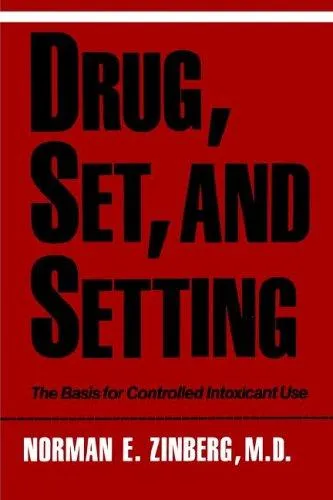
Drug, Set, and Setting
The Basis for Controlled Intoxicant Use
Our Review
Drug, Set, and Setting presents Zinberg's research finding that the majority of users of even highly addictive substances (opiates, psychedelics, cannabis) maintain controlled, non-problematic patterns of use — a finding that contradicted the dominant "one use leads to addiction" model of the 1980s. Through extensive interviews and longitudinal data, Zinberg demonstrates that social rituals, informal sanctions, and learned norms of use (collectively, "setting") are as important as pharmacology in determining whether drug use becomes problematic. JAMA called it "cogently written" and "well worth reading."
We should be honest that this is the most academic title in this recommendation set — it is published by Yale University Press and written in a scholarly register. However, it is not a statistics textbook or dry clinical manual; Zinberg writes accessibly and illustrates his arguments with compelling case studies and real-world examples. The core insight — that "set and setting" is a three-variable model, not a slogan — is so important that it deserves its place despite the academic tone. The limitation is that Zinberg died in 1989 and the book predates the modern psychedelic renaissance, so readers won't find discussion of contemporary microdosing or psychedelic-assisted therapy.
For microdosing practitioners, this is the theoretical origin of concepts they use daily. Every time a microdosing protocol specifies "journal your mood," "choose a comfortable environment," or "set an intention before dosing," it is applying Zinberg's framework. Understanding the theory behind these practices — rather than just following instructions — helps practitioners make better decisions and adapt protocols to their own circumstances. This book explains why set and setting matter, not just that they matter.
Key Takeaways
- ✓ Drug effects are determined by three interacting variables — the pharmacological properties of the substance (drug), the user's personality, expectations, and mental state (set), and the physical and social environment of use (setting) — neglecting any one variable produces an incomplete picture
- ✓ Most users of psychoactive substances, including opiates and psychedelics, develop controlled use patterns through informal social learning — the "inevitable addiction" narrative is empirically false for the majority of users
- ✓ Social rituals and sanctions (informal rules about when, where, how, and how much to use) are the primary mechanism through which communities maintain controlled use — this directly parallels how microdosing protocols function
- ✓ Prohibition disrupts the development of controlled-use norms by driving use underground, where social learning about safe practices cannot occur — this insight explains why harm-reduction education is more effective than criminalization
- ✓ The concept of "set and setting" is not a vague suggestion but a falsifiable scientific model that predicts drug outcomes — treating it with the same rigor as dosage and pharmacology improves both safety and efficacy
Who Should Read This
Readers who want to understand the scientific foundation of harm-reduction philosophy and the "set and setting" concept at a deeper level than popular accounts provide. Recommended for harm-reduction practitioners, therapists working with psychedelic clients, and thoughtful microdosers who want to understand the theory behind their protocols — not just follow them.
Available Editions
Related Content
Related Protocols
Related Substances
Related Terms
Important Legal Notice
⚠️ Personal Responsibility
You use this application entirely at your own risk and responsibility. MicrodosingDiary is only a tool for recording personal experiences.
🚫 Not a Medical Service
This application IS NOT a medical tool, does not provide medical advice, does not diagnose or treat any conditions. Always consult a qualified physician.
⚖️ Legislation and Laws
Many substances used for microdosing are illegal in many countries. Users are fully responsible for complying with local laws. The application does not support or promote illegal activity.
❌ No Guarantees
We provide no guarantees regarding results, safety or efficacy of microdosing. All information is for informational purposes only.
🔞 Age Restriction
Application is intended only for persons over 18 years of age. By using the application you confirm that you are an adult.
🔒 Data Privacy
Your diary entries are private and encrypted. The application is for personal use. Public-page analytics is described in Privacy and Terms.
By using this application you accept all the above risks and waive any claims against the application operator.