The Harvard Psychedelic Club
How Timothy Leary, Ram Dass, Huston Smith, and Andrew Weil Killed the Fifties and Ushered in a New Age for America
Our Review
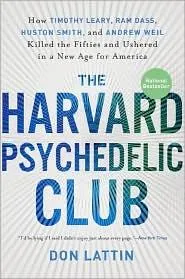
The Harvard Psychedelic Club tells the origin story of the modern psychedelic movement through the lives of four people whose paths diverged radically after their shared Harvard experience. Leary became the infamous countercultural icon who may have set back psychedelic research by decades. Ram Dass (Richard Alpert) became America's most beloved spiritual teacher. Huston Smith became the preeminent scholar of world religions. Andrew Weil became the pioneer of integrative medicine. Lattin tracks how a single research project produced such different life trajectories, and what each man's path reveals about the opportunities and pitfalls of psychedelic exploration.
The book won the 2010 California Book Award (Silver Medal) for nonfiction and was a national bestseller. Booklist gave it a starred review, calling it "a terrific social history" with "laugh-aloud passages." What makes it valuable for our audience is its honest, balanced portrait of all four figures — including Leary's recklessness, Ram Dass's initial naiveté, Smith's academic caution, and Weil's quiet rebellion. The limitation is that it focuses primarily on the 1960s and 1970s, with only brief treatment of the decades that followed.
For microdosing practitioners, this book illuminates the different ways people integrate psychedelic insights into their lives. The four paths — advocacy (Leary), devotion (Ram Dass), scholarship (Smith), and healing practice (Weil) — represent archetypes that microdosers still navigate today. Understanding how these pioneers succeeded and failed in bringing psychedelic insights into mainstream culture provides a map for anyone trying to integrate their own practice with their public and professional life.
Key Takeaways
- ✓ The Harvard Psilocybin Project (1960–1963) was the first major academic program to study psychedelics in a spiritual context — its success and subsequent shutdown established the template for the tension between psychedelic research and institutional authority that persists today
- ✓ Timothy Leary's shift from cautious researcher to public evangelist illustrates the risk of losing scientific credibility through advocacy — a cautionary tale relevant to anyone who talks publicly about their psychedelic or microdosing practice
- ✓ Andrew Weil's trajectory — from Harvard freshman who helped expose Leary to founder of integrative medicine — shows how psychedelic insights can be channeled into mainstream healing without evangelism or stigma
- ✓ Ram Dass's transformation from ambitious Harvard psychologist to spiritual teacher demonstrates that psychedelic experiences can catalyze genuine spiritual development, but only when followed by decades of disciplined practice and integration
- ✓ The personal conflicts between these four men (Weil reported Leary to the administration, leading to his firing) reveal that the psychedelic community has always contained tensions between caution and enthusiasm, science and spirituality, privacy and advocacy
Who Should Read This
Anyone curious about how the modern psychedelic and wellness movements began, told through the very human stories of their founders. Ideal for readers who have already encountered some of these figures (Ram Dass's Be Here Now and Huston Smith's Cleansing the Doors of Perception are in the database) and want to understand the relationships and conflicts behind the books.
Available Editions
Related Content
Related Substances
Related Terms
Important Legal Notice
⚠️ Personal Responsibility
You use this application entirely at your own risk and responsibility. MicrodosingDiary is only a tool for recording personal experiences.
🚫 Not a Medical Service
This application IS NOT a medical tool, does not provide medical advice, does not diagnose or treat any conditions. Always consult a qualified physician.
⚖️ Legislation and Laws
Many substances used for microdosing are illegal in many countries. Users are fully responsible for complying with local laws. The application does not support or promote illegal activity.
❌ No Guarantees
We provide no guarantees regarding results, safety or efficacy of microdosing. All information is for informational purposes only.
🔞 Age Restriction
Application is intended only for persons over 18 years of age. By using the application you confirm that you are an adult.
🔒 Data Privacy
Your diary entries are private and encrypted. The application is for personal use. Public-page analytics is described in Privacy and Terms.
By using this application you accept all the above risks and waive any claims against the application operator.