Integration
What is integration?
Integration is the bridge between experience and lasting change. It's the deliberate process of taking whatever you notice, feel, or learn during a microdosing practice and translating it into concrete changes in your daily life — your habits, relationships, work, self-understanding, and behavior.
Without integration, insights fade. That moment of clarity about your relationship pattern on Tuesday is forgotten by Thursday. The creative connection you made during a dose day never makes it into your project. Integration is what makes the difference between "interesting experience" and "actual transformation."
Why integration is essential
Insights are perishable
The human brain is remarkably good at returning to its default patterns. A shift in perspective during a microdose is temporary unless actively anchored through reflection and action.
Microdosing is a catalyst, not a cure
Microdosing doesn't fix things by itself. It may open windows of enhanced neuroplasticity, emotional openness, and cognitive flexibility — but you have to actively climb through those windows. Integration is the climbing.
The compound effect
A single integrated insight might seem small. But over weeks and months of a microdosing practice, accumulated small integrations create significant shifts in how you think, feel, and behave.
The integration process
1. Notice
Pay attention to what arises during and after dosing:
- New perspectives on old problems
- Emotional releases or realizations
- Creative ideas or connections
- Shifts in how you relate to people
- Changes in body awareness or habits
- Recurring themes across multiple sessions
2. Capture
Record your observations before they fade:
- Journaling — the primary integration tool
- Voice memos — capture thoughts in the moment
- Tracking apps — systematic data collection
- Art or creative expression — sometimes insights are pre-verbal
3. Reflect
Make sense of what you've captured:
- What patterns are emerging across sessions?
- What themes keep recurring?
- What insights feel most important or urgent?
- What am I avoiding or resisting?
4. Act
Translate insights into concrete behavioral changes:
- Start a difficult conversation you've been avoiding
- Change a habit that you've recognized as harmful
- Begin a creative project that's been calling to you
- Set a boundary that you've identified as needed
- Seek professional support for patterns that feel too big to handle alone
5. Review
Periodically zoom out and assess the bigger picture:
- How has my baseline shifted over the past month?
- Which integrations have stuck? Which have faded?
- What's the next area that needs attention?
Integration practices
Daily (5–10 minutes)
- Morning intention before dosing
- Evening journaling — what did I notice today?
- Gratitude or highlight — one thing that stood out
Weekly (20–30 minutes)
- Review tracking data — look for patterns across the week
- Theme identification — what's the recurring message?
- One action commitment — what's one small thing I'll do differently next week?
Per protocol cycle (1–2 hours)
- Deep reflection during the break between cycles
- Assessment — is this practice serving me? How?
- Adjustment — what do I want to focus on in the next cycle?
Ongoing support
- Therapy or coaching — professional support for deeper patterns
- Integration circle — peer support group
- Trusted friend or partner — someone to process with
- Creative practice — art, music, writing as integration
- Body-based practices — yoga, dance, somatic work
Common integration mistakes
- Collecting insights without acting — journaling about the same realization 10 times without doing anything about it
- Expecting the substance to do the work — waiting for change instead of creating it
- Intellectualizing instead of feeling — analyzing your emotions rather than experiencing them
- Rushing the process — trying to integrate everything at once instead of focusing on one thing at a time
- Skipping the break — the rest period between protocol cycles is prime integration time
Related Terms
Recommended Books
How to Change Your Mind
Michael Pollan (2018)
A groundbreaking exploration of the renaissance in psychedelic research. Michael Pollan takes readers on a journey through the history, science, and personal experience of psychedelic substances.

A Really Good Day
Ayelet Waldman (2017)
A candid memoir of one woman's month-long experiment with microdosing LSD. Ayelet Waldman documents how tiny doses of the substance transformed her daily life while exploring the science, history, and politics of psychedelics.
The Psychedelic Explorer's Guide
James Fadiman (2011)
The definitive handbook for safe psychedelic use. James Fadiman distills decades of research and thousands of session reports into practical guidance covering microdosing, therapeutic sessions, and high-dose experiences.
Be Here Now
Ram Dass (1971)
The foundational countercultural classic in which Richard Alpert — Harvard psychologist turned spiritual teacher Ram Dass — traces his journey from psychedelic experimentation to Eastern spiritual practice, offering a roadmap for integrating transcendent experience into everyday life.
LSD: Doorway to the Numinous
Stanislav Grof (1975)
Based on approximately 2,500 clinical LSD sessions over 17 years, Stanislav Grof maps three domains of the human unconscious — the psychodynamic, the perinatal, and the transpersonal — demonstrating how LSD acts as a nonspecific amplifier of unconscious processes.
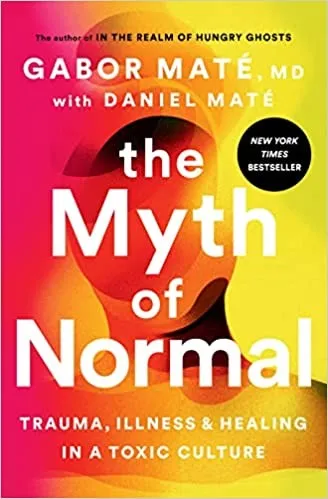
The Myth of Normal
Gabor Maté (2022)
Gabor Maté's most ambitious work investigates why chronic illness, mental health disorders, and addiction are soaring in Western societies. Drawing on four decades of clinical experience, he connects individual suffering to the toxic culture of modern life and provides a compassionate framework for healing.