Acid Dreams
The Complete Social History of LSD: The CIA, the Sixties, and Beyond
Our Review
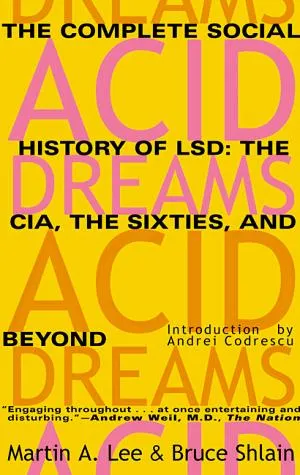
Acid Dreams is divided into two parts: "The Roots of Psychedelia" covers the CIA's covert LSD research program and the scientific community's early experiments, while "Acid for the Masses" follows the substance into the counterculture and chronicles the political and cultural war that followed. Lee and Shlain draw on declassified CIA documents, congressional hearing transcripts, and firsthand interviews to construct a meticulously documented narrative. The San Francisco Chronicle called it "a generalist's history that should replace all others," and the writing is genuinely gripping — part investigative journalism, part cultural history.
What makes this book irreplaceable is its scope and documentation. No other single volume covers the full arc from MK-Ultra to the Grateful Dead to the DEA with this level of primary-source research. The revised 1992 edition includes a new introduction by Andrei Codrescu and an afterword updating events through the early 1990s. The limitation is that it ends before the modern psychedelic renaissance — it tells you how we got to prohibition but not how we're getting out of it. Readers should pair it with more recent titles (Pollan, Sessa, Shroder) for the contemporary picture.
For microdosing practitioners, Acid Dreams provides essential context for understanding the legal and cultural landscape they operate within. The book documents in detail how LSD went from a promising psychiatric medicine to a Schedule I substance — not because of scientific evidence of harm, but because of political and cultural panic. Understanding this history helps microdosers engage more intelligently with the ongoing debates around decriminalization and psychedelic policy reform.
Key Takeaways
- ✓ The CIA tested LSD on unwitting civilians, prisoners, and its own agents in the MK-Ultra program, hoping to develop a mind-control weapon — this covert program inadvertently helped spread LSD into American culture
- ✓ LSD showed remarkable promise in treating alcoholism, anxiety, and depression in clinical trials during the 1950s and early 1960s — this therapeutic potential was abandoned due to political pressure, not scientific failure
- ✓ The prohibition of LSD was driven primarily by its association with the antiwar movement and counterculture, not by evidence of medical harm — the Schedule I classification explicitly contradicted the scientific consensus of the era
- ✓ The distinction between controlled clinical research and uncontrolled recreational use was the critical variable — when research protocols were followed, outcomes were overwhelmingly positive; when they weren't, problems emerged
- ✓ Media sensationalism about LSD (chromosome damage claims, "staring at the sun" myths) was largely debunked by later research but had already caused irreversible policy damage
Who Should Read This
Anyone interested in understanding how psychedelics became illegal and why that history matters for the current renaissance. Essential for readers who want the full backstory behind the substances they work with — from CIA black sites to Haight-Ashbury to the modern decriminalization movement.
Available Editions
Related Content
Related Substances
Related Terms
Important Legal Notice
⚠️ Personal Responsibility
You use this application entirely at your own risk and responsibility. MicrodosingDiary is only a tool for recording personal experiences.
🚫 Not a Medical Service
This application IS NOT a medical tool, does not provide medical advice, does not diagnose or treat any conditions. Always consult a qualified physician.
⚖️ Legislation and Laws
Many substances used for microdosing are illegal in many countries. Users are fully responsible for complying with local laws. The application does not support or promote illegal activity.
❌ No Guarantees
We provide no guarantees regarding results, safety or efficacy of microdosing. All information is for informational purposes only.
🔞 Age Restriction
Application is intended only for persons over 18 years of age. By using the application you confirm that you are an adult.
🔒 Data Privacy
Your diary entries are private and encrypted. The application is for personal use. Public-page analytics is described in Privacy and Terms.
By using this application you accept all the above risks and waive any claims against the application operator.