Psychonaut
What is a psychonaut?
The term psychonaut comes from the Greek psychē (soul/mind) and naútēs (sailor/navigator) — literally, a "sailor of the mind." A psychonaut is someone who deliberately and systematically explores altered states of consciousness for purposes of:
- Self-knowledge — understanding the nature of one's own mind, emotions, and patterns
- Spiritual exploration — seeking transcendent or mystical experiences
- Psychological growth — working through personal challenges and developing resilience
- Philosophical inquiry — exploring questions about consciousness, reality, and existence
- Creative expansion — accessing novel states of awareness for creative inspiration
Psychonautics can involve various methods:
- Psychedelic substances — the most commonly associated tool
- Meditation and breathwork — non-pharmacological approaches to altered states
- Sensory deprivation — float tanks, darkness retreats
- Lucid dreaming — conscious exploration of the dream state
- Holotropic breathwork — a technique developed by Stanislav Grof
Why it matters for microdosing
The psychonaut mindset provides valuable context for microdosing:
- Intentional approach — psychonauts bring a spirit of deliberate inquiry rather than casual or recreational use
- Documentation — the tradition of detailed trip reports and journaling aligns perfectly with microdosing best practices
- Community knowledge — decades of psychonaut experience have generated practical wisdom about dosing, set and setting, and integration
- Harm reduction culture — experienced psychonauts typically prioritize safety, testing, and informed consent
- Spectrum perspective — understanding microdosing as one point on a broader spectrum of psychedelic exploration
What to watch out for
- Ego trap — identifying as a psychonaut can become its own ego identity; the goal is exploration, not a label
- Escalation risk — the desire for deeper experiences can lead to increasingly risky behavior
- Echo chambers — psychonaut communities can develop insular worldviews that normalize risky practices
- Spiritual materialism — collecting "experiences" without genuine integration or growth
- Balance — the most effective psychonauts maintain grounded, functional lives alongside their exploration
Related Terms
Recommended Books

PiHKAL: A Chemical Love Story
Alexander Shulgin, Ann Shulgin (1991)
The most iconic book in psychedelic chemistry — part intimate love story memoir, part encyclopedic reference documenting 179 phenethylamine compounds with synthesis routes, precise dosage ranges, durations, and first-person experience reports. Written by Alexander "Sasha" Shulgin, who personally synthesized and bioassayed over 230 novel psychoactive compounds including popularizing MDMA for psychotherapy.

Acid Dreams
Martin A. Lee, Bruce Shlain (1985)
The definitive social history of LSD, tracing the substance from its synthesis by Albert Hofmann in 1938 through CIA mind-control experiments (MK-Ultra), the Harvard Psilocybin Project, the counterculture explosion of the 1960s, and the backlash that led to prohibition. Drawn partly from declassified government files, the book reveals how LSD shaped — and was shaped by — some of the most turbulent decades of American history.

The Brotherhood of the Screaming Abyss
Dennis McKenna (2012)
Dennis McKenna's memoir of growing up with his brother Terence McKenna and their legendary 1971 expedition to La Chorrera, Colombia, where experiments with psilocybin mushrooms and ayahuasca produced experiences so extreme they challenged both brothers' understanding of reality. Equal parts love story, adventure narrative, and philosophical meditation on the nature of consciousness.

The Way of the Psychonaut
Stanislav Grof (2019)
Written in his late eighties, this is Stanislav Grof's magnum opus — a comprehensive synthesis of over sixty years of consciousness research through psychedelic-assisted therapy and Holotropic Breathwork. Volume One covers maps of the psyche, the architecture of emotional disorders, perinatal matrices, spiritual emergency, and a fundamental revision of depth psychology based on non-ordinary states of consciousness.
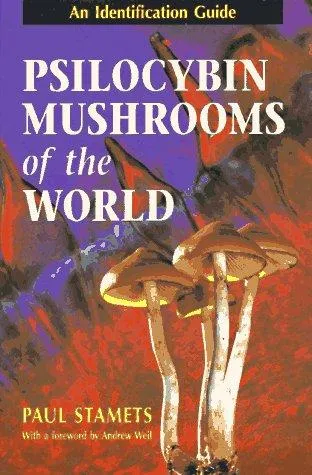
Psilocybin Mushrooms of the World
Paul Stamets (1996)
The standard field guide to psilocybin-containing mushrooms, written by the mycologist whose name is on the Stamets microdosing protocol. Detailed descriptions and colour photographs of more than 100 species, plus a rigorous method for telling them apart from their poisonous look-alikes.

The Cosmic Serpent
Jeremy Narby (1998)
An anthropologist's account of ayahuasca among the Ashaninca of the Peruvian Amazon, and the bold hypothesis it led him to: that the twin serpents of shamanic vision and the double helix of DNA may be the same thing seen from two sides. A cult classic that has shaped how a generation thinks about plant medicine and indigenous knowledge.