Psilocybin Mushrooms of the World
An Identification Guide
Our Review
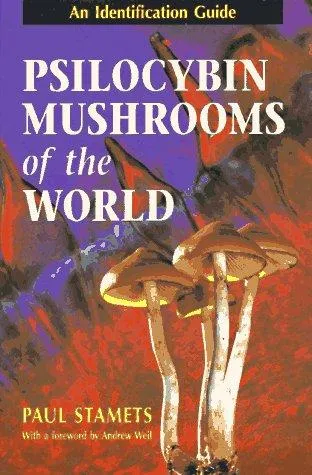
Paul Stamets is better known to microdosers for the Stamets Stack — psilocybin, lion's mane and niacin, taken four days on and three days off — but this 1996 field guide is the book that made his reputation among mycologists. It describes over 100 psilocybin-containing species from every continent, each with a colour photograph, a botanical description, habitat notes, a distribution map and a frank note on potency. Species of Psilocybe, Panaeolus, Gymnopilus, Pluteus, Conocybe and Inocybe are all covered, with the most detail reserved for the Psilocybe species that people actually encounter: cubensis, semilanceata, cyanescens, azurescens and mexicana among them.
The heart of the book is not the species list but the method. Stamets insists on a systematic approach to identification — spore prints, bluing reaction, habitat, season, microscopic features — and devotes an entire section to the deadly look-alikes, especially Galerina species that grow on the same wood as Psilocybe cyanescens and azurescens. Andrew Weil's foreword and Stamets's own opening chapters place the mushrooms in their cultural and historical context, but the tone throughout is that of a careful scientist rather than an advocate. The limitation is age: the taxonomy has moved on since 1996, several species have been renamed, and the photographs are of their era.
For microdosing practitioners this book fills a gap that no amount of protocol advice can. Anyone working with whole mushrooms rather than a standardised extract needs to understand why potency varies so much between species, between specimens and between fresh and dried material — and Stamets explains it clearly. It also makes the strongest possible case for never consuming a mushroom you have not identified with certainty. Read alongside the Stamets protocol page, it explains where the man's ideas came from.
Key Takeaways
- ✓ Psilocybin content varies enormously between species and even between specimens of the same species, which is why homogenising dried material matters for consistent microdoses
- ✓ The bluing reaction is a useful indicator of psilocybin but not a proof of identity — several dangerous species also bruise blue-green
- ✓ Deadly Galerina species share habitat and appearance with wood-loving Psilocybe species, making certain identification a matter of life and death
- ✓ A spore print, habitat, season and microscopic features together give a reliable identification; no single feature is enough
- ✓ Psilocybin mushrooms grow on every inhabited continent and have been used ceremonially for millennia, long before they had a Latin name
Who Should Read This
Anyone who works with whole psilocybin mushrooms rather than a measured extract and wants to understand what they are taking. Essential for people following the Stamets protocol who are curious about its author, for amateur mycologists, and for anyone who has ever wondered why two doses of the same weight can feel so different.
Available Editions
Related Content
Related Protocols
Related Substances
Psilocybe azurescens
Psilocybe cyanescens
Psilocybe semilanceata
Psilocybe cubensis
Psilocybin
Psilocybe mexicana
Related Terms
Important Legal Notice
⚠️ Personal Responsibility
You use this application entirely at your own risk and responsibility. MicrodosingDiary is only a tool for recording personal experiences.
🚫 Not a Medical Service
This application IS NOT a medical tool, does not provide medical advice, does not diagnose or treat any conditions. Always consult a qualified physician.
⚖️ Legislation and Laws
Many substances used for microdosing are illegal in many countries. Users are fully responsible for complying with local laws. The application does not support or promote illegal activity.
❌ No Guarantees
We provide no guarantees regarding results, safety or efficacy of microdosing. All information is for informational purposes only.
🔞 Age Restriction
Application is intended only for persons over 18 years of age. By using the application you confirm that you are an adult.
🔒 Data Privacy
Your diary entries are private and encrypted. The application is for personal use. Public-page analytics is described in Privacy and Terms.
By using this application you accept all the above risks and waive any claims against the application operator.