On this page
What is it?
**Psilocybe cyanescens**, commonly known as "Wavy Caps," ranks among the most potent psilocybin-containing mushrooms globally, with alkaloid concentrations **1.5-2× higher than P. cubensis**. This species presents unique safety considerations including critical identification challenges with deadly lookalikes and the poorly understood "wood lover's paralysis" phenomenon.
**Taxonomy and Classification**
| Rank | Classification |
|------|----------------|
| Kingdom | Fungi |
| Phylum | Basidiomycota |
| Class | Agaricomycetes |
| Order | Agaricales |
| Family | Hymenogastraceae |
| Genus | *Psilocybe* |
| Species | *P. cyanescens* Wakef. |
**Physical Description**
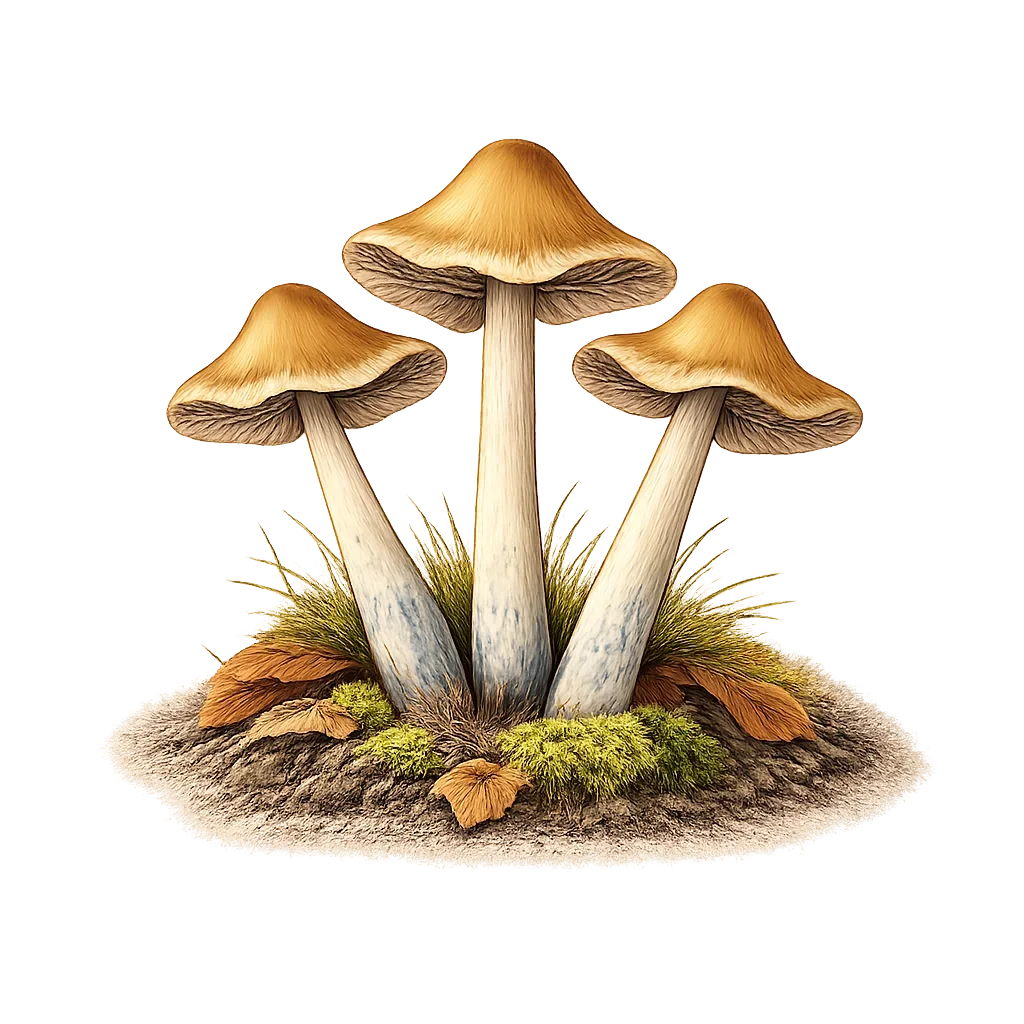
- **Cap (Pileus):** 1.5-6 cm diameter; caramel to chestnut-brown when moist (hygrophanous), fading to pale buff when dry; develops **distinctively wavy margins at maturity**—the signature characteristic
- **Gills:** Adnate to slightly sinuate; initially pale tan, maturing to dark purple-brown
- **Stem (Stipe):** 3-9 cm tall; white, covered with silvery fibers; **bruises intensely blue when handled**
- **Spore print:** Dark purple-brown to purple-black
- **Odor and taste:** Farinaceous (flour-like)
- **Spores:** Smooth, elliptical, 9-14 × 5-8 µm
**Geographic Distribution**
P. cyanescens has spread globally through the commercial mulch trade. Established populations exist across:
- **Pacific Northwest:** Washington, Oregon, British Columbia, Northern California
- **Europe:** United Kingdom (spreading northward), Western and Central Europe
- **Southern Hemisphere:** New Zealand, parts of Australia
The species is **exclusively saprotrophic on lignin-rich wood debris**, thriving in urban environments with decorative woodchip mulching around roses, rhododendrons, and azaleas. Single sites have produced over 100,000 fruiting bodies.
**Critical Warning: Galerina marginata Identification**
**Misidentification of G. marginata as P. cyanescens can be fatal.** Both species grow in identical habitats and can fruit side-by-side. Galerina contains the same amatoxins as Death Cap mushrooms.
| Feature | P. cyanescens (safe) | G. marginata (deadly) |
|---------|---------------------|----------------------|
| **Spore print** | Purple-brown to purple-black | Rusty brown to cinnamon |
| **Bruising** | Stains blue when handled | Never stains blue |
| **Cap margin** | Distinctively wavy at maturity | Remains convex, rarely wavy |
| **Ring/annulus** | Absent or cortinate | Membranous ring (may disappear) |
**A spore print is essential for safe identification. Each individual mushroom must be identified separately.**
🚨 Important Warnings
Please read all warnings carefully before use.
HIGH POTENCY: P. cyanescens contains up to 1.96% total alkaloids—approximately 1.5-2× more potent than P. cubensis. Reduce microdose by 50% compared to P. cubensis (0.05-0.15g vs 0.1-0.3g). Use precision scales.
WOOD LOVER'S PARALYSIS (WLP): P. cyanescens is associated with temporary motor weakness or paralysis lasting up to 24 hours. Symptoms: difficulty walking (80%), swallowing (26%), breathing (17%). WLP does NOT occur with P. cubensis. Do not combine with respiratory depressants.
CONTRAINDICATIONS: Do not use if you have personal/family history of schizophrenia, psychosis, or bipolar I disorder. Do not use during pregnancy or breastfeeding. Do not combine with MAOIs.
LEGAL STATUS: Psilocybin remains illegal in most jurisdictions. Legal status varies significantly by location. Verify local laws before any activity.
DEADLY LOOKALIKE: Galerina marginata grows in identical habitats and can fruit side-by-side with P. cyanescens. Misidentification is potentially fatal—Galerina contains lethal amatoxins. 10 specimens could kill a child. ALWAYS confirm via spore print (purple-black = P. cyanescens; rusty brown = Galerina) and blue bruising.
LITHIUM INTERACTION: Never combine with lithium. 47% of lithium + psychedelic reports involved seizures. This is the most dangerous documented drug interaction with classic psychedelics.
⚠️ Interactions & Combinations
Important information about drug interactions and combinations. Always consult a physician before combining.
Lithium (Mood Stabilizer)
Dangerous - Seizure Risk
A 2021 Johns Hopkins survey (Nayak et al.) found that **47% of 62 lithium + psychedelic reports involved seizures**, with 39% requiring medical attention. Of 6 reports specifically involving lithium + psilocybin, 33% resulted in seizures. The mechanism likely involves pharmacodynamic interaction—lithium may lower seizure threshold while psychedelics increase cortical excitability. **This is the most dangerous documented drug interaction with classic psychedelics.**
MAOIs (Monoamine Oxidase Inhibitors)
Dangerous Potentiation / Serotonin Syndrome Risk
Psilocin is a MAO-A substrate (4-33% metabolized via MAO-A). MAOI inhibition significantly potentiates and prolongs effects unpredictably. A 2024 case report documented hypertensive emergency with myocardial infarction in a patient on tranylcypromine who consumed 1g P. cubensis. Allow minimum 2 weeks washout after irreversible MAOIs.
SSRIs (Selective Serotonin Reuptake Inhibitors)
Blunted/Reduced Effects
Survey data indicates **47% of SSRI users report attenuated psychedelic effects**. Effect blunting may persist 3-6 months after discontinuation (fluoxetine's long half-life requires 6+ weeks washout). A 2022 clinical study co-administering escitalopram and psilocybin showed no signs of serotonin toxicity and actually reduced anxious ego dissolution. SSRIs are not absolutely contraindicated but effects may be diminished. **DO NOT self-taper SSRIs.**
SNRIs (Serotonin-Norepinephrine Reuptake Inhibitors)
Blunted/Reduced Effects
Similar to SSRIs, with 55% reporting weaker effects in surveys. Effect blunting may persist for weeks after discontinuation.
Antipsychotics
Blocks/Abolishes Effects
Atypical antipsychotics have high affinity for 5-HT2A receptors as antagonists. RCTs show 98-99% blocking with risperidone 1mg. Used clinically as "trip terminators" when needed. Note: Haloperidol (typical antipsychotic) does NOT block perceptual effects and **increases anxiety and dysphoria by 27%**—inferior to atypical antipsychotics.
Tricyclic Antidepressants
Potentially Increased/Intensified Effects (Unpredictable)
Unlike SSRIs, TCAs may intensify psychedelic experiences due to postsynaptic receptor sensitization. Clomipramine poses highest serotonin syndrome risk. Taper 2+ weeks under medical supervision before use.
Cannabis
Unpredictable Synergy
Strong, unpredictable synergy that significantly intensifies the psychedelic experience. Increased likelihood of challenging experiences, anxiety, and paranoia.
Benzodiazepines
Reduces Anxiety / Rescue Medication
Low risk; used in harm reduction and clinical research as rescue medication for acute distress. Does not directly block 5-HT2A but reduces anxiety via GABA-A modulation.
💊 Dosage Guidelines
Typical dosage ranges from sub-perceptual microdoses to full psychoactive doses
Microdose
0.05 g
Sub-perceptual
Threshold
0.1 g
First noticeable effects
Moderate
1.0 g
Full effects
Strong
2.0 g
Intense experience
🧪 Preparation
Preparation methods and handling tips for accurate dosing.
**Critical Warning for P. cyanescens**
P. cyanescens requires **precision scales with 0.01g accuracy minimum** due to its 1.5-2× higher potency compared to P. cubensis. A small measurement error has significantly larger consequences.
---
**Method 1: Precision Capsule Method** (Recommended)
*Best for: Most consistent, accurate microdosing*
**Required:** Precision scale (0.01g minimum), coffee grinder, empty capsules (size 0 or 00), capsule filling machine (optional), nitrile gloves, airtight container with desiccant.
**Steps:**
1. Ensure complete drying (cracker-crisp)
2. Weigh total material before grinding
3. Grind to fine, uniform powder (homogenizes potency variation)
4. **P. cyanescens dose: 50-150mg (0.05-0.15g) for microdosing**
5. Tare scale with empty capsule; add powder to target weight
6. Fill and seal capsules; label with date, species, dosage
**Storage:** Airtight container with desiccant, cool/dark/dry location
**Shelf life:** 6-12 months; potency degrades faster once ground
**Example:** 1 gram dried P. cyanescens = approximately 7-20 microdoses at 50-150mg each
---
**Method 2: Honey Infusion ("Blue Honey")**
*Best for: Long-term storage, masking taste*
**⚠️ WARNING:** Makes precise dosing more difficult. Due to P. cyanescens' higher potency, the capsule method is preferred.
**Steps:**
1. Weigh total dried powder; calculate total doses
2. Add to raw organic honey in sterilized jar
3. Stir thoroughly; store sealed in cool, dark place
4. Turn/shake every few days for 2-3 weeks
5. Weigh honey portions (not volume) for dosing
**Critical note:** Uneven powder distribution makes consistent dosing challenging for high-potency species. Prepare very dilute mixtures and start extremely low.
---
**Drying Guidelines**
- **Temperature:** Below 40°C (104°F); psilocybin degrades above 137°C
- **Method:** Food dehydrator at lowest setting, or freeze-drying (optimal)
- **Goal:** Cracker-dry—should snap, not bend
- **Time:** 24-48 hours depending on humidity and mushroom size
Capsule Method
The gold standard for microdosing high-potency species. Dried mushrooms are ground to powder and weighed into capsules for consistent, tasteless, portable doses.
Steps:
- Ensure mushrooms are cracker-dry (should snap, not bend)
- Grind to a fine, uniform powder for consistent potency
- Weigh desired amount per capsule (0.05-0.15g for P. cyanescens)
- Fill capsules manually or with a capsule machine
- Verify weight (subtract empty capsule weight ~0.05g)
- Label with species, dosage, and date
Blue Honey Method
Honey acts as a natural preservative; mushroom powder is infused in honey for a shelf-stable preparation. Less precise dosing than capsules.
Steps:
- Dry mushrooms completely and grind to fine powder
- Calculate total doses based on weight
- Layer mushroom powder with raw honey in sterilized glass jar
- Seal and store in cool, dark place
- Turn/shake every few days for 2-3 weeks
- Dose by weighing honey portions (not volume)
📋 Microdosing Protocols
Recommended protocols and regimens for microdosing this substance.
Fadiman Protocol (adapted for P. cyanescens)
Dosage:
- Dried Mushrooms: 50-150mg (0.05-0.15g) — approximately 50% of P. cubensis dose
Schedule:
Day 1: microdose, Day 2-3: off, repeat
The most widely used microdosing protocol, adapted for P. cyanescens' higher potency. Sub-perceptual is the goal—if you feel "high," the dose is too high.
Detailed Schedule:
- Day 1: Take microdose in the morning with light food
- Day 2: Transition day - observe residual effects (afterglow)
- Day 3: Normal day - reset/baseline
- Day 4: Repeat with microdose
Stamets Stack (adapted for P. cyanescens)
Dosage:
- Niacin: 25-50mg (flush form)
- Lion's Mane: 50-200mg extract
- P Cyanescens: 50-100mg dried
Schedule:
Days 1-4: stack, Days 5-7: off
Combines three components for hypothesized synergistic neurogenesis benefits. A 2022 study found adults over 55 using the Stamets Stack showed ~40% greater improvement in psychomotor performance. Recommended for experienced microdosers only.
Detailed Schedule:
- Days 1-4: Take all three components together in morning
- Days 5-7: Complete break from all components
- Repeat cycle for 4 weeks
- Take 2-4 week break before next cycle
✨ Reported Effects
Mood Enhancement
Observational studies indicate small-to-medium improvements in positive affect and reductions in negative mood
Mental Health Support
Small-to-medium reductions in depression, anxiety, and stress symptoms reported in surveys
Enhanced Creativity
May enhance divergent thinking and originality; 71-77% of microdosers cite creativity as motivation
Neuroplasticity Support
Promotes structural and functional neuroplasticity via 5-HT2A receptor activation; increased synaptic density observed
⚠️ Safety Information
HIGH POTENCY WARNING: P. cyanescens contains up to 1.96% total alkaloids (0.30-1.68% psilocybin)—approximately 1.5-2× more potent than P. cubensis. Adjust doses accordingly: typical microdose 0.05-0.15g dried (vs. 0.1-0.3g for P. cubensis).
WOOD LOVER'S PARALYSIS (WLP): This species is associated with temporary motor weakness or paralysis lasting up to 24 hours. Symptoms include difficulty walking (80% of cases), swallowing (26%), and breathing (17%). WLP is NOT reported with P. cubensis.
DEADLY LOOKALIKE: Galerina marginata (Deadly Galerina) grows in identical habitats and can fruit side-by-side with P. cyanescens. Misidentification is potentially fatal—Galerina contains the same amatoxins as Death Cap mushrooms. ALWAYS confirm identity via spore print (purple-black for P. cyanescens, rusty brown for Galerina) and blue bruising.
ABSOLUTE CONTRAINDICATIONS: Personal/family history of schizophrenia or psychosis, bipolar I disorder, lithium use (47% seizure rate in combination reports), MAOI use, pregnancy/breastfeeding.
🔬 Scientific Research
Current research findings and clinical studies.
Phase 2b COMP360 trial. 25mg psilocybin showed significant MADRS reduction at week 3 vs 1mg control (p<0.001). Response: 37% vs 18%. **Safety note:** Suicidal ideation reported across groups, higher in 25mg arm.
Head-to-head comparison: psilocybin vs escitalopram for depression. No significant difference on primary endpoint (QIDS-SR-16), but response rates favored psilocybin (70% vs 48%) and remission rates (57% vs 28%). Both well-tolerated.
Waiting-list controlled trial. Large effect sizes (Cohen's d=2.2). 12-month follow-up showed sustained benefits (75% response, 58% remission).
Placebo-controlled (niacin). Significant antidepressant effect; response 57% vs 22%. **No serious adverse events; no suicidality reported.**
Double-blind placebo-controlled study of 0.5g P. cubensis. No evidence supporting enhanced well-being, creativity, or cognitive function. Subjective effects significant only in participants who correctly guessed their condition, suggesting expectancy effects.
fMRI study demonstrating decreased brain network modularity (increased integration) correlating with antidepressant response. Escitalopram showed no such changes—suggesting psilocybin works via distinct mechanism.
⚖️ Legal Status
Current legal status in various jurisdictions. Always respect local laws.
| Jurisdiction | Status | Details |
|---|---|---|
|
United States (Federal)
(1970) |
Schedule I - Illegal
|
Psilocybin classified as Schedule I under the Controlled Substances Act (1970)—"high abuse potential, no accepted medical use." FDA has granted Breakthrough Therapy Designation for treatment-resistant depression research. Possession: up to 1 year; Distribution: up to 20 years. |
|
Oregon
(2020) |
Legal - Supervised Therapeutic Use (21+)
|
Oregon Measure 109 (2020) legalized supervised therapeutic use, operational since June 2023. Approximately **10,000 clients served** through ~24 service centers. Sessions cost $1,200-$3,000 (no insurance coverage). Multiple counties have opted out. P. cyanescens grows naturally in Oregon. |
|
Colorado
(2022) |
Decriminalized for adults 21+; Licensed centers opening 2025
|
Proposition 122 (2022) decriminalized possession and cultivation for adults 21+. Licensed healing centers opening in 2025. Counties cannot opt out. |
|
Decriminalized US Cities
(2019) |
Decriminalized (possession)
|
Denver (2019), Oakland (2019), Santa Cruz (2020), Ann Arbor (2020), Washington D.C. (2020), Seattle (2021), Detroit (2021). Decriminalization means lowest law enforcement priority, not legalization. |
|
Netherlands
(2008) |
Fresh truffles legal; dried mushrooms illegal
|
Psilocybin mushrooms banned in 2008. Fresh psilocybin truffles (sclerotia) remain legal and sold in smart shops. P. cyanescens does not form significant sclerotia. |
|
Czech Republic
(2025) |
Medical psilocybin legal (effective January 1, 2026)
|
Czech Republic became **first EU country** to legalize psilocybin-assisted therapy for treatment-resistant depression (signed July 2025). Only synthetic psilocybin permitted; administered in certified psychiatric clinics with 2 qualified therapists; maximum 75mg/month. 68% of Czechs support doctor-prescribed psychedelic therapy. Natural mushrooms including P. cyanescens remain prohibited outside small-quantity decriminalization. |
|
Canada
(1974) |
Schedule III - Illegal with exemptions
|
Access via Section 56(1) exemptions (case-by-case approval from Health Canada) and Special Access Program (practitioners request for serious conditions). ~57 psilocybin dispensaries operate across 15 cities with uneven enforcement. |
|
United Kingdom
(1971) |
Class A - Illegal
|
Same category as heroin and cocaine under the Misuse of Drugs Act 1971. Possession: up to 7 years imprisonment. Schedule 1 status requires Home Office license for research. **Spores remain legal** (contain no psilocybin); germinating them is illegal production. P. cyanescens grows naturally throughout southern Britain. |
|
Australia
(2023) |
Schedule 8 for therapy (July 2023)
|
Rescheduled from Schedule 9 to Schedule 8 for treatment-resistant depression via Authorised Prescriber Scheme. Treatment costs approximately $25,000-35,000. |
| Jamaica |
Fully legal (never prohibited)
|
Psilocybin mushrooms were never prohibited in Jamaica. Commercial retreat industry thriving. |
👤 Key Figures
Notable figures associated with the research and history of this substance.
Elsie Maud Wakefield
British mycologist, first describer of P. cyanescens
Formally described P. cyanescens in 1946 based on specimens from Royal Botanic Gardens, Kew, London. Served as **Head of Mycology at Kew Gardens from 1915-1951**, becoming the first woman to hold this position. Published nearly 100 papers on fungi. The genera *Wakefieldia* and *Wakefieldiomyces* were named in her honor.
Gastón Guzmán
Mycologist, taxonomist
Authored major taxonomic works on the Psilocybe genus.
Roger Heim
Mycologist
Co-authored early scientific studies on psilocybin mushrooms and advanced classification of the genus.
Paul Stamets
Mycologist, author, entrepreneur
Founder of Fungi Perfecti; documented numerous wood-loving Psilocybe species including P. cyanescens, P. azurescens, and P. allenii. His 1996 book "Psilocybin Mushrooms of the World" remains the definitive field identification guide. Developed the **Stamets Stack protocol**—combining psilocybin with lion's mane and niacin. A 2022 Nature Scientific Reports study found adults over 55 using the Stamets Stack showed ~40% greater improvement in psychomotor performance.
James Fadiman, PhD
Psychologist, "Father of Microdosing"
Co-founded the Institute of Transpersonal Psychology. Pioneered systematic microdosing research beginning in the 1960s. His 2011 book "The Psychedelic Explorer's Guide" introduced the **Fadiman Protocol**—a three-day cycle (dose, transition day, normal day)—which remains the most widely followed microdosing regimen. Collected over 1,850 self-reports from 59 countries.
Albert Hofmann
Chemist
Isolated psilocybin and psilocin, enabling scientific study of Psilocybe species.
Roland Griffiths, PhD
Psychopharmacologist, Johns Hopkins professor
Founded the Johns Hopkins Center for Psychedelic and Consciousness Research (2019). **First researcher to obtain FDA/DEA approval** to reinitiate psilocybin research in healthy volunteers after a 40-year hiatus. His landmark 2006 study demonstrating psilocybin's capacity to occasion mystical experiences with sustained personal meaning effectively relaunched legitimate psychedelic science.
Robin Carhart-Harris, PhD
Neuroscientist, UCSF professor
Founded Imperial College London's Centre for Psychedelic Research (2019), now Ralph Metzner Distinguished Professor at UCSF. His neuroimaging studies revealed psilocybin's effects on the default mode network and led to the **"entropic brain hypothesis."** The 2021 NEJM trial comparing psilocybin to escitalopram represents a landmark head-to-head comparison with standard antidepressant treatment.
📚 Scientific Research
Johns Hopkins Center for Psychedelic Research
Leading psilocybin research institution
https://hopkinspsychedelic.org/MAPS - Psilocybin Resources
Multidisciplinary Association for Psychedelic Studies
https://maps.org/tag/psilocybin/Erowid P. cyanescens Vault
Species-specific information and experience reports
https://erowid.org/plants/mushrooms/mushrooms_cyanescens.shtmlPaul Stamets - Fungi Perfecti
Resources from the author of "Psilocybin Mushrooms of the World"
https://paulstamets.com/❓ FAQ
**How long does onset take?**
Effects typically begin 20-40 minutes after oral ingestion. Tea preparations may begin slightly faster (15-30 minutes). Peak effects occur 1.6-2.2 hours after ingestion, with total duration of 4-6 hours. Due to higher potency, effects may feel more intense at equivalent psilocybin doses compared to P. cubensis.
**How should P. cyanescens be stored?**
Store completely dried material (cracker-dry) in airtight containers with desiccant packets in a cool, dark, dry location. Properly stored dried mushrooms maintain potency for 1-2+ years. Ground powder degrades faster than whole specimens. Avoid temperatures above 40°C (104°F) and UV/sunlight exposure.
**What is wood lover's paralysis (WLP)?**
WLP is temporary motor weakness or paralysis reported specifically after consuming wood-loving Psilocybe species including P. cyanescens, P. azurescens, and P. subaeruginosa. It is **NOT reported with P. cubensis**. Symptoms include:
- Difficulty walking (80% of reported cases; 53% completely unable at peak)
- Difficulty swallowing (26%)
- Difficulty breathing (17%)
- Sensory loss (50%)
Duration can be up to 24 hours. The leading hypothesis involves aeruginascin, a compound found in wood-loving species that may metabolize to a substance causing neuromuscular junction blockade.
**How should dosages be adjusted from P. cubensis?**
Due to P. cyanescens' approximately 1.5-2× higher potency:
- P. cubensis microdose: 0.1-0.3g → **P. cyanescens: 0.05-0.15g**
- P. cubensis moderate: 2-3.5g → **P. cyanescens: 1-2g**
- Use a precision scale (0.01g minimum accuracy)
- Always start at the lower end and titrate up slowly
**Can it be combined with the Stamets Stack?**
The Stamets Stack (psilocybin + lion's mane + niacin) can be used with P. cyanescens, but doses must be adjusted for higher potency. A 2022 study found adults over 55 using the Stamets Stack showed approximately 40% greater improvement in psychomotor performance compared to psilocybin alone. Complete a basic psilocybin-only cycle first to establish baseline sensitivity.
**How to distinguish from deadly Galerina marginata?**
This is critical—both species grow in identical woodchip habitats:
1. **Spore print:** P. cyanescens = purple-black; Galerina = rusty brown
2. **Blue bruising:** P. cyanescens = intense blue; Galerina = never blue
3. **Cap margin:** P. cyanescens = wavy at maturity; Galerina = convex
4. **Identify each mushroom individually**—they can fruit side by side
Galerina contains lethal amatoxins. 10 fruiting bodies could kill a child.
Recommended Books
Your Psilocybin Mushroom Companion
Michelle Janikian (2019)
A comprehensive, beginner-friendly guide to psilocybin mushrooms covering everything from planning safe trips and training guides to microdosing protocols and psychedelic therapy. Journalist Michelle Janikian pairs the latest research with practical, step-by-step advice for both newcomers and experienced users, emphasizing harm reduction throughout.
Psilocybin Mushrooms of the World
Paul Stamets (1996)
The standard field guide to psilocybin-containing mushrooms, written by the mycologist whose name is on the Stamets microdosing protocol. Detailed descriptions and colour photographs of more than 100 species, plus a rigorous method for telling them apart from their poisonous look-alikes.
Important Legal Notice
⚠️ Personal Responsibility
You use this application entirely at your own risk and responsibility. MicrodosingDiary is only a tool for recording personal experiences.
🚫 Not a Medical Service
This application IS NOT a medical tool, does not provide medical advice, does not diagnose or treat any conditions. Always consult a qualified physician.
⚖️ Legislation and Laws
Many substances used for microdosing are illegal in many countries. Users are fully responsible for complying with local laws. The application does not support or promote illegal activity.
❌ No Guarantees
We provide no guarantees regarding results, safety or efficacy of microdosing. All information is for informational purposes only.
🔞 Age Restriction
Application is intended only for persons over 18 years of age. By using the application you confirm that you are an adult.
🔒 Data Privacy
Your diary entries are private and encrypted. The application is for personal use. Public-page analytics is described in Privacy and Terms.
By using this application you accept all the above risks and waive any claims against the application operator.